
This is a rather long and technical article. Feel free to skip if you are not fan of engine stuff.
During our two weeks of refitting the hull, at one point we got to know Oscar. Owner of a ten-meter steel yacht he was there during those days to keep his boat in the flawless shape that it is … always. He was of great help and gave us a ton of advice and most of all he is a good man; Not only back then but also later (but that is a story of itself). He even had a boat mechanic come to check on his engine and made it a gift to also send his mechanic to our boat for the old Volvo Penta MD17C. We did some test runs and he basically told us, that the engine (if not the exhaust is rusting) seems to be in very good shape – and it was not rusting. Because the tank and the pipes were very old and we found water and dirt in the fuel system, we changed all filters and mounted a jerry rigged fuel can to the engine, to out rule any fouling in the two-year-old diesel fuel that was sitting in the original tank for two winters. The engine was running smoothly – starting every time and giving the sound of a tractor. Did you know that you kill these kind of old diesel engines by cutting them off the fuel? You basically let it die out. We thought this was amazing.
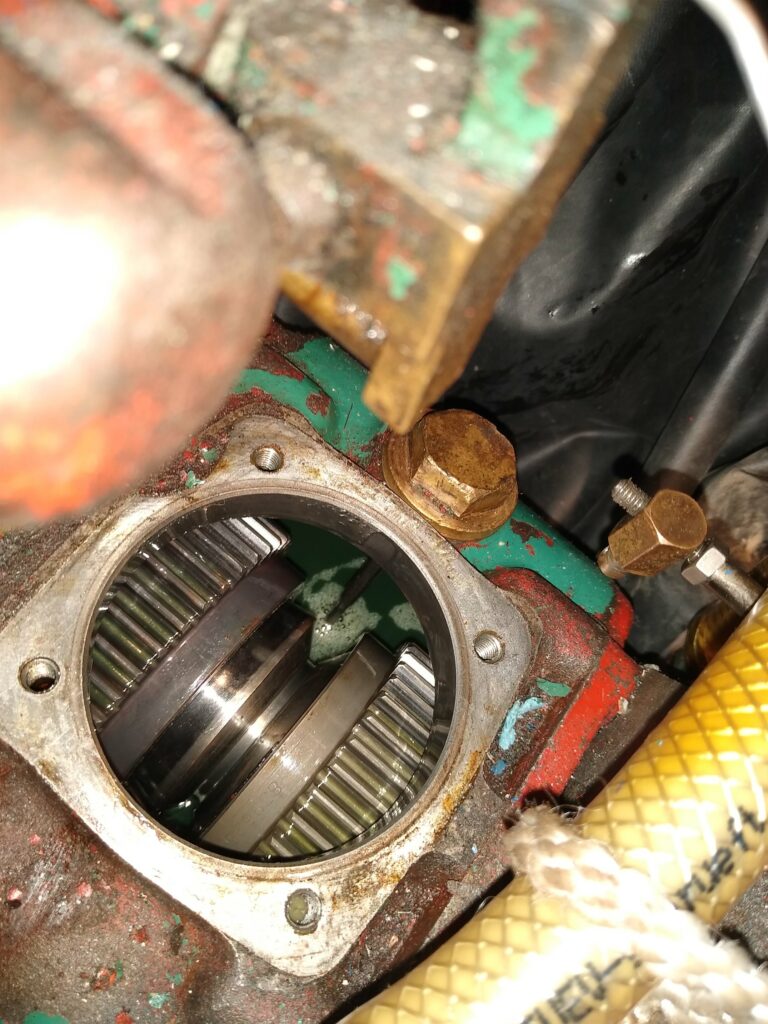
We were told that the previous owner of our boat had issues with the reverse gear. And at first we had the same issues, then we refilled the gear box with its designated oil and now it was working. And we thought “that was the easiest fix ever”. Little did we know.
In story telling now I skip forward to the time when we were already at the sailing clubs Wannsee harbor.
One day with calm winds we wanted to try some “docking” at a buoy in the middle of Wannsee…. And the engine was not going into reverse. Shit. For those who are not familiar with boats… the reverse gear in a boat is basically it’s only real brake. And docking without one is rather adventurous. We managed to get back to the dock safe and now knew we had bigger problems. In the Caribbean for example you basically anchor whenever you want. In Berlin and its channels towards the Baltic Sea there is quite a few locks and docking and marinas and so on … where you need that reverse! So it was not an option to delay this issues. That gear box sits in a very tight space behind the engine in the aft of the boat and you can only get to it by deconstructing a lot in the aft cabins. A shitload of work… and we didn’t even know what we had to do. Taking the gear box out of the boat was not an option because it would have meant out hauling and maybe disassembling parts of the propeller shaft or maybe even the engine. No no no.
Frist we did a full
oil change and not only topping it up. This took one full day and a couple a
small female hands but long story short – it didn’t change a thing. The reverse
gear did not work. Well…. only one out of 10 attempts it didn’t. When it was
in, it didn’t “grind” it was rock solid in. So we ruled out that teeth of the
crankset where missing. We were already thinking about putting an outboard
motor on the boat (temporary) to manage the channels towards the Baltic Sea,
when Benni decided to have a last look into the top lid of the gear box. This
was now accessible because he rebuilt the aft cabins and now could crawl deep
into the aft of the boat. He took off the lid, where the cables actually go
into the box for shifting, took it off and looked down into the abyss. You can
actually shift with your pinky and then manually turn the propeller shaft to
look if the gear is locked-in. We figured that it works, only that you have to
shift it a little beyond a certain point. So we decided that the metal part
that translates cable pull into motion for shifting could be altered (grinded)
that it pushes the reverse a little further. A brave decision, since gear boxes
are built VERY prices and half a millimeter can make it not function any more.
But since we only worked on one part of the metal piece (called shifting shoe),
we figured that we could only cause it to “still not function”. Nothing to lose
right? Until the shifting shoe fell into the gearbox while testing stuff. Deep
down in a bathtub of oil underneath the gears. Holy shit. Praying to Neptune
that the piece is magnetic we build a magnetic fishing rod and Benni managed to
get the shifiting shoe back up.
Now we proudly present the real fix:
For additional angle we did not mount the lid back level, but with a slight
angle. A Russian fix as I call it now. But as you may have figured by now, this
did the trick. Now – nine out of ten
times, the reverse gear works. It does not sound very happy, but we have to use
it very rarely.
So no outboard engine, and no collisions in locks. This project was actually only finished 6 days before we took off to the Baltic sea.